

Whether to opt for a dental implant or a prosthetic crown is one of the most common questions when a tooth is missing. The choice between them depends on several factors, including whether the tooth can still be restored or whether it needs to be completely replaced. To find out how these options differ, what the treatment involves and how much it costs, please read on.
Dental implants or prosthetic crowns – what are they and how do they differ?
The difference between these solutions stems primarily from what exactly they restore in the mouth. A prosthetic crown strengthens a tooth that is still present but has been weakened, fractured or has undergone root canal treatment. In such cases, the aim is to preserve the natural tooth and restore its function.
An implant, on the other hand, is used when a tooth cannot be has been preserved or has already been removed. In such cases, it replaces the missing root and provides a stable foundation for a prosthetic restoration. This makes it possible to restore the entire tooth from scratch, in terms of both function and aesthetics.
IMPORTANT! The decision as to whether to opt for a dental implant or a prosthetic crown has a direct impact on the long-term stability of the bite and the distribution of forces within the mouth. Inappropriate treatment or a delay in treatment can lead to tooth movement, excessive stress and a gradual loss of balance in the entire masticatory system.
You can read more about the consequences of not replacing a missing tooth in our article “Missing tooth - when you need to fill the gap left by an extracted tooth.”

What does the treatment look like and how long does it last?
In practice, the decision as to whether to use a dental implant or a prosthetic crown also affects the entire course of treatment and its duration.
Restoring a tooth with a crown is a relatively quick procedure and is carried out on a tooth that is still in the mouth. The tooth is prepared appropriately, and then a scan or impression is taken, on the basis of which the crown is fabricated in a prosthetic laboratory. The whole process usually requires several visits, depending on the clinical circumstances.
The implant procedure is more complex and takes longer. An implant requires surgery, during which it is inserted into the upper or lower jawbone. This is followed by a period of healing and osseointegration, which can take from a few weeks to several months. Only after this stage is it possible to fabricate and fit the prosthetic crown.
The differences between these options relate not only to the procedure itself, but also to the extent to which it affects the tissues and the time required to complete the treatment. Alternatively, in cases of missing teeth, the following is also used: dental bridges and removable dentures. Bridges are supported by the adjacent teeth, whilst removable dentures are used to replace larger gaps in the dentition.
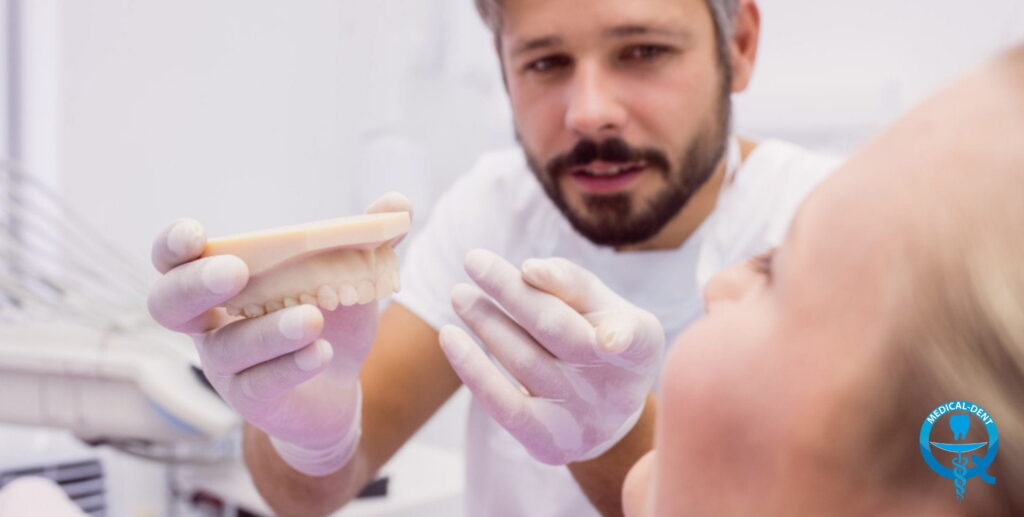
Dental implant or prosthetic crown – price
The cost of treatment is one of the factors patients take into account when deciding whether to opt for a dental implant or a prosthetic crown. A prosthetic crown is usually the cheaper option, as it makes use of the existing tooth and does not require surgery. An implant involves a greater financial outlay, as it encompasses both the surgical procedure and the subsequent prosthetic restoration.
However, it is not worth basing your decision solely on price. What matters far more is which solution will be appropriate for your clinical situation.
A o jakich kosztach mówimy? W naszym gabinecie ceny koron protetycznych zaczynają się od £500, implantów według aktualnego cennika implantów. Jeśli martwisz się jednorazowym, dużym wydatkiem, w naszym gabinecie możesz skorzystać z systemu ratalnego. Co ważne pierwsze 12 rat to zerowe oprocentowanie, a nasz system jest regulowany przez Financial Conduct Authority (FCA number 619628).
You can find more information on this topic in the article „Teeth on credit: dental treatment on hire purchase" or contact us.